
Aging services for older adults with a history of trauma, including Holocaust survivors, have seen extraordinary growth and developments as more care agencies embrace the person-centered, trauma-informed (PCTI) approach.
“We have to talk about trauma and how it impacts us as we age. We have to talk about PCTI care,” said Shelley Rood Wernick, Associate Vice President of Jewish Federations of North America’s Center on Aging, Trauma, and Holocaust Survivor Care (“the Center”), and the granddaughter of Holocaust survivors. “In most cases, trauma is hidden. It is covered up. So, we have to know that it’s buried, assume that it’s there, and act accordingly.”
For the past 11 years, the Center has been entrusted by the federal government as the National Resource Center on Aging and Trauma. The Center provides trainings, tools, and grant funding to dozens of organizations across the United States that engage in this work, culminating in 244 grants across 25 states. So far, the Center has served 50,000 Holocaust survivors, 26,000 other older adults with a history of trauma, and 11,000 family caregivers. Over those 11 years, subgrantees have also trained 27,000 professionals and volunteers in PCTI care.
During the most recent grant period, subgrantees served 5,855 Holocaust survivors, 15,263 older adults with a history of trauma, 2,670 family caregivers, and trained 4,705 professionals and volunteers.
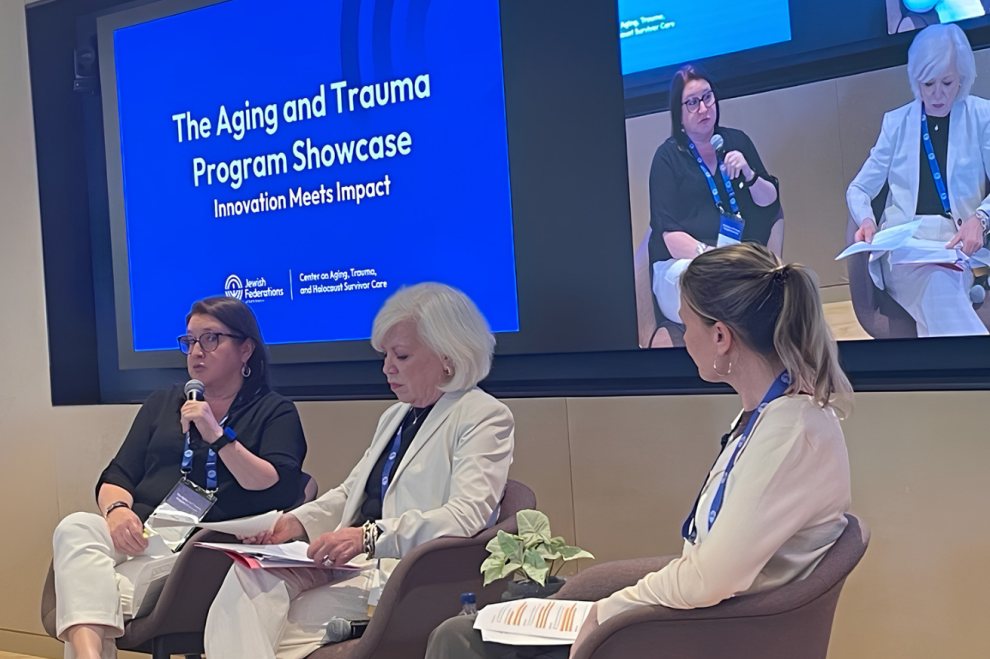
This incredible work was on full display during the Center’s inaugural Aging & Trauma Program Showcase, held at Federations’ Washington, D.C., flagship public affairs office. The event brought together 35 subgrantees, who throughout the day gave presentations about the projects that the Center’s funding has allowed them to pursue.
From meditation and wellness classes to dental care and Russian-language activities, these subgrantees provide support for the physical, emotional, and social well-being of the survivors and other older adults with a history of trauma in their communities. They are pioneers in the cause of advancing PCTI care, ensuring that it becomes the baseline for aging services across the U.S.
The Center’s work is supported by the Administration for Community Living (ACL), whose Principal Deputy Administrator Mary Lazare was a keynote speaker. During her remarks, Lazare recounted her 19 years of experience working at a Jewish care home in St. Louis, Missouri.
“I never thought I would ever meet a Holocaust survivor,” Lazare said. “What a privilege that was for me, because that was where my growth started. What you are doing – whether they’re a Holocaust survivor or another person who’s experienced trauma – your work is changing their life and allowing for growth, for new opportunity to get beyond the trauma, to experience comfort in their life.”
Other speakers included Josh Goldberg of the Boulder Crest Foundation, Dr. Richard Tedeschi of the Boulder Crest Institute, Dr. Joan Gillece of the National Association of State Mental Health Program Directors, and Jennifer Spoeri of the National Adult Protective Services Association.
Attendees left inspired and feeling reaffirmed in their work. The Showcase allowed them to learn from each other, picking up new best practices and strategies to ensure they continue to provide the best possible care to their clients. In the process, they carry on the Center’s mission: to make sure trauma is acknowledged as a public health matter, and that the person-centered, trauma-informed approach is taught and implemented everywhere older adults are supported.
You can watch the plenaries below:
Healthy Aging through Post-Traumatic Growth
Health Aging through Caregiving and Family Ties
The Aging & Trauma Program Showcase: Innovation Meets Impact was supported by the following sponsors and partners: the Sephardic Foundation on Aging, Aging Life Care Association, Brownstein Hyatt Farber Schrek, the Claims Conference, Dignity Memorial, the Harry and Jeanette Weinberg Foundation, Jackrabbit LX, the National Center on Elder Abuse, NewOrg Management System, Ropes & Gray, and Sacred Spaces.
This work is supported by the Administration for Community Living (ACL), the United States Department of Health and Human Services (HHS) as part of a financial assistance award totaling $8,389,500 with 75% funded by ACL/HHS and $2,796,500 and 25% funded by non-government source(s). The contents are those of the author(s) and do not necessarily represent the official views of, nor an endorsement, by ACL/HHS, or the United States Government.
0Comments
Add CommentPlease login to leave a comment